

On May 5th, Canada’s semiconductor elite gathered at the CHIPS North Executive Summit at the Brookstreet Hotel in Ottawa to discuss the future of Canada’s semiconductor ecosystem. And it turns out Minister of Artificial Intelligence and Digital Innovation Evan Solomon was there.
That morning, down the hall, I gave the opening keynote at the finance-focused portion of the day — the Ottawa Tech Investment Summit — to a room of Canadian founders and investors. Terry Matthews, who has founded four Canadian tech unicorns and who nobody in that room needs an introduction to, opened the event and introduced me - someone much less accomplished.
I said, in that room, that it was 2026 and Canada still did not have a national semiconductor strategy. And it needed one… pretty innocuous…
But three days later, Minister Solomon told BetaKit that Canada will not pursue one.
Canada is the only G7 country without a standalone strategy.
Fun times.
— — —
There is one more thing worth noting before you read what I said.
The day before the summit, Industry Minister Mélanie Joly announced at the events opening dinner, that the federal government intends to spin out the National Research Council’s Canadian Photonics Fabrication Centre — the CPFC — into a commercial entity. The CPFC, established in Ottawa in 2005, is the only end-to-end compound semiconductor facility of its kind in North America. It is probably, without hyperbole, the anchor of our existing Canadian Semiconductor ecosystem.
It is also, not coincidentally, the facility that made GaN Systems possible.
When Nortel collapsed and its semiconductor labs were purchased by the NRC for pennies on the dollar, my father went to that facility and accessed the gallium nitride equipment that allowed him to design the chips that became GaN Systems. The fertilizer from Nortel’s collapse — just as Microsystems International’s collapse had seeded the generation before — landed at the CPFC. And from it grew a company that now powers electric cars in Europe.
The government is now privatizing that facility. That may or may not be the right move — there are thoughtful people who believe commercializing the CPFC is exactly the right plan, and the comparison to Taiwan’s early support of TSMC is not unserious. John Ruffolo has called it a “critical lynchpin” for Canadian sovereignty. I am genuinely open to that argument.
But here is what I cannot reconcile: three days after announcing the privatization of the only compound semiconductor facility in North America, Minister Solomon told BetaKit that Canada does not need a national semiconductor strategy.
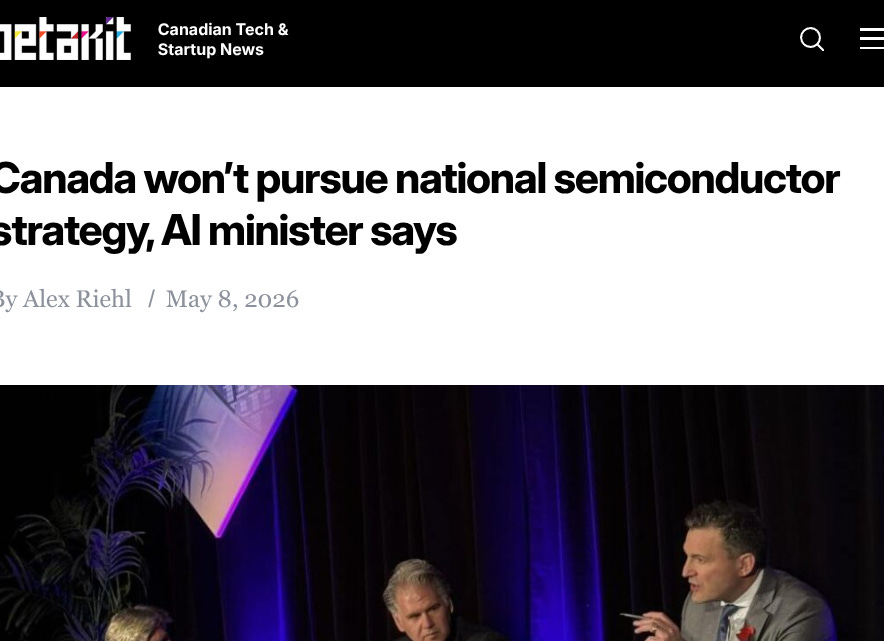
When you are privatizing a national semiconductor asset. You are making a consequential, irreversible structural decision about the future of Canada’s semiconductor capability. And you are doing it without a strategy.
Sometimes having no strategy is a strategy in and of itself.
But a proper strategy would tell us: what happens to the researchers at the CPFC when the commercial incentives of a private entity diverge from the public interest of training the next generation of Canadian semiconductor engineers? What happens to the small Canadian companies that currently access the facility at subsidized rates — the ones who are not yet commercial enough to pay market prices? What metrics will we use to decide, in five years, whether this was the right call?
Without a strategy, we won’t know the answers to those questions until it’s too late to ask them.
Canada has been here before.
Microsystems International was also a government-backed semiconductor initiative that ended without a plan for what came next. The difference is that its failure was accidental — the fertilizer it produced was unintentional. We don’t get to be accidentally brilliant twice.
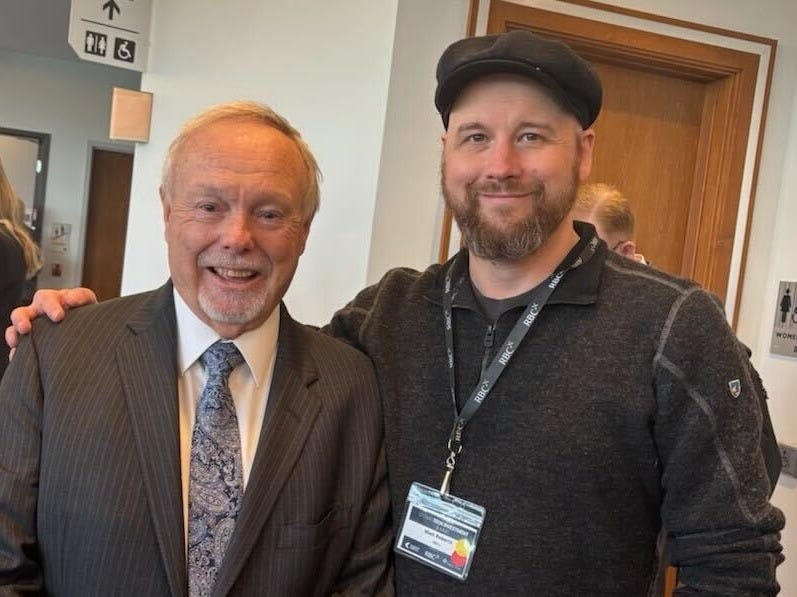
What I said in my keynote on the morning of May 5th stands probably more strongly today then at the hour it was delivered. Here it is, after Terry Matthews was kind enough to introduce me to the room.
— — —
Thank You, Terry
Terry Matthews is the reason I have a career. He got me a co-op at Newbridge Networks when I was fifteen or sixteen years old. When I graduated from university, he invited me to come work at Wesley Clover — at the time a small family office, six or seven people. I was effectively Terry’s bagman. Literally carrying his bags in and out of hotels as we travelled.
I’ve watched Terry up close for most of my professional life, and what people see from the outside — four Canadian tech unicorns, the Key to the City of Ottawa, a knighthood — doesn’t capture what he actually does. What Terry does is show up. Consistently. For decades. For people who are decades younger than him, who have no obvious claim on his time.
He showed up for me. And I wanted to say that publicly, in a room full of people who have benefited from the same thing, because it matters.
The Weather
I believe there is a common element to successful entrepreneurship in Ottawa. It’s not the government. It’s not the university pipeline. It’s not even the semiconductor heritage, though we’ll get to that.
It’s the weather.
Or more precisely — what the weather forces you to learn.
On my drive in from the airport the night before the event, my taxi driver told me the story of how Terry Matthews got rich. The story goes: Terry and his co-founder Mike wanted to sell electric lawnmowers. By the time the lawnmowers arrived — or maybe they never arrived at all — it was winter. Sales died. Terry pivoted into telecommunications and started a company called Mitel.
I didn’t have the heart to tell the driver that Terry was speaking at the event I was going to.
The Mitel lawnmower story is interesting because it may or may not be literally true. Mitel conveniently also stands for Microelectronic Telecommunications — which is a considerably better name for a telecom company than Mike and Terry’s Lawnmowers. But that’s almost beside the point. The story Terry tells with it is a lesson: if you don’t have a customer before you get the product to them, you don’t have a customer. Validate before you build. Know your demand before you commit.
In 2005, another Ottawa entrepreneur learned the same lesson. He wanted to show off some new e-commerce technology, so he built a website that sold custom snowboards — Snowdevil. It was a beautiful site, and it won awards. Then spring came and interest in snowboards declined. But what the founder — Tobi Lütke — noticed was that people hadn’t been coming to Snowdevil to buy snowboards. They’d been coming because the store itself was remarkable. The technology behind it was what people wanted.
He reworked the backend over the summer and relaunched nine months later. We know it as Shopify today.
Both Terry and Tobi blame the weather. What they’re both telling you is the same lesson: the problem wasn’t the weather. It was timing the demand.
Today we’re in what I’d call a venture winter. Capital is scarce, rounds are slow, and the temptation is to wait it out. The lesson of Mitel and Shopify is that the winter is not the problem. Your relationship to timing is the problem. The founders who come out of this cycle will be the ones who used the cold to validate ruthlessly, not the ones who waited for spring.
Ottawa’s DNA
People tell me venture capital in Canada is a young industry. I’ve been in it for twenty years — with Terry, then at BDC, then in the Private Venture markets. To say it’s new is a little bit of a lie.
Terry raised venture capital in 1975 from one of Canada’s earliest VC firms, a company called Helix run by a man named Ben Webster. Most people in the industry today don’t know who Ben Webster is. But he was a giant in his lifetime.
Terry was in Ottawa in 1975 because in the mid-sixties, the Canadian government decided that semiconductors were strategically important. Together with Northern Telecom — Nortel — they funded a company called Microsystems International. The equivalent of several hundred million dollars in today’s money, to build a semiconductor fab here in Ottawa. The thesis: design and manufacture chips in Canada, put them into Nortel’s equipment, sell them into Bell and telcos around the world.
There was one problem. Almost nobody in Canada knew anything about semiconductors. So Microsystems went to Europe and recruited. A recruiter went to South Wales and came back with Terry Matthews and thirty or forty other graduates from the same engineering program. My father was one of them. Growing up, we used to call it the Welsh mafia — you couldn’t turn around in Ottawa’s tech scene without bumping into another Welshman who’d come over in the sixties or seventies to work at Microsystems or one of its spinoffs.
It failed. It was, in Terry’s own words — and I am not paraphrasing — “a whole load of shit.”
But sometimes shit is fertilizer.
Twenty years after Microsystems collapsed, within three or four miles of that original fab, there were companies worth over sixty-five billion dollars — all founded by ex-Microsystems employees. It may be the most successful industrial failure in Canadian history.
From 1993 to 2002, Ottawa received between forty and fifty percent of all venture capital deployed in Canada. Every year. Semiconductors. Telecom. MedTech. Early CleanTech. A virtuous cycle — companies started here, they sold to each other, they went public, VCs got returns, and they invested back in. It worked.
Then it stopped working.
The Capital Crisis
In 2000, Canadian VCs raised five billion dollars. By 2008, that number had fallen to one point two billion. It was a collapse — driven by the dot-com crash, accelerated by Nortel’s unravelling, compounded by the fact that when our best companies were acquired, the capital that came back didn’t stay here.
The government stepped in with a program called VCAP. By 2016 we were back to $2.2 billion. By 2021 — riding cheap money and pandemic enthusiasm — we hit $5.1 billion. Twenty-one years to beat the 2000 number. Not inflation adjusted.
Today we’re at $2.1 billion. Another collapse. Inflation-adjusted, we are near where we were in the late nineties.
But the headline number isn’t the real story. The structure of what’s left is what concerns me.
In 2025, five funds captured eighty-three percent of all capital raised in Canada. Five. The highest concentration our venture market has ever recorded. Two years before that, forty-six percent was considered shockingly high. When five funds control eighty-three percent of the market, founders stop pursuing genuinely novel ideas and start building for a narrow set of fund theses. That is not how you build the next great company.
Emerging managers — the funds that write the first cheques into the sectors nobody else is watching — raised just $250 million in 2025. The lowest number on record since the late nineties.
The question I keep asking is: how much longer can Canada rely on government funds masquerading as venture capital to fill this gap?
The Maple Eight — our pension funds — are investors in the top twenty US venture funds. They are literally funding the companies that acquire Canadian companies. With your money and mine. 72 percent of capital going into successful Canadian companies at the growth stage is now coming from outside Canada. Only 32 percent of deals by logo count involve foreign capital — but seventy-two percent by dollar value. American VCs are coming in at the growth stage, once Canadian capital has dried up, and taking the returns.
There has not been a meaningful Tech IPO on the TSX venture exchange in three years. The recycling cycle that powered this ecosystem in the nineties is broken.
There is a word for deploying capital everywhere in the world except your own backyard. It’s not a strategy. It’s a bad habit.
My Dad
I want to tell you a story about my father.
When I come to Ottawa, I am usually introduced as John Roberts’s son. It’s only recently that my father has started to be known as Matt Roberts’s father. I think he would have found that funny.
My father was one of those semiconductor engineers recruited to Canada by Microsystems International. When Microsystems collapsed, he went on to work at various telecom and semiconductor companies, founded a number of them, and eventually made his exit in the early 2000s. By 2008, he was sixty-five years old. Unlike Terry Matthews, he thought about winding down.
His passion was audio. He was an audiophile of the most committed kind — the kind who spends ten or twelve thousand dollars on a pair of speakers and still isn’t satisfied. He had a specific problem with every speaker he bought: a reverb, a static, a distortion he couldn’t eliminate. And like any engineer, he decided he could do better.
He wanted speakers that sounded almost like someone whispering in your ear.
I was one hundred percent against this project. Because that was my inheritance he was spending.
The more he dug in, the more he realized the problem wasn’t his speaker design. Like any good engineer when confronted with an unsolvable problem — he blamed his tools. The issue was in the amplifiers. Built on semiconductor processes designed in the late eighties and nineties, those chips retained electrical charge as they pulsed on and off. That residual charge created distortion. Distortion is the enemy of great audio.
So he went looking for a better substrate. He knew about gallium nitride but had always considered it impractical. Then Nortel went bankrupt. The NRC purchased Nortel’s fabrication equipment for pennies on the dollar — and that equipment ended up at the Canadian Photonics Fabrication Centre. My father knew the engineers there.
My Dad designed a new chip architecture specifically for GaN — technology he subsequently patented as Island Technology. The innovation made the chips roughly a quarter of the size of competing solutions. Four times the yield on the same wafer. About twenty-five percent of the cost.
He was an engineer, not a marketing man. He called the company GaN Systems. For Gallium Nitride - and to show of his amazing marketing skills.
Angels here in Ottawa stepped up — retired semiconductor engineers taking twenty-five thousand dollars out of their retirement savings and putting it into a power semiconductor company. Then GaN Systems needed a Series A.
To get venture capital interest in 2011, we could not use the word semiconductor. Clean tech was in. Semis were out. So we reframed it — power efficient devices — and raised from Rockport Capital out of Boston and Chrysalix Ventures out of Vancouver. We were the only company the CVCA listed under semiconductors that year. It was the last year they tracked the category.
The chips worked. GaN Systems eventually became the number one gallium nitride semiconductor developer in the world. Right here. Out of this ecosystem. Because my father was trying to build a better speaker.
He never stopped believing the audio amplifier would come. He wrote technical articles about GaN’s amplifier chips from his bed while he was ill.
He passed away before he got to see it fully happen. But he knew they were coming. He knew they were going to work.
I’m not telling you this for sentiment. I’m telling you this because it’s a capital story and a people story.
When GaN Systems exited to Infineon for nearly nine hundred million US in 2023, the venture capitalists who had taken the risk with me — who had shown up at that terrifying Series A moment — none of them were still at their firms. They had all left. I received congratulations from people at those funds I had never heard of.
The same pattern is playing out with Xanadu, the quantum computing company. Many of the people who made the early bets are no longer in the rooms where those decisions get made. The institutional knowledge and risk vs reward thesis walks out the door with them.
Deep tech companies take ten, twelve, fifteen years from first cheque to real outcome. Our ecosystem is not doing a good enough job of retaining the people willing to take risk at the earliest, scariest moments. The firms keep the brand. The people leave. And we rebuild from scratch every cycle.
The reason people say Canadian venture is young is not because it’s young. It’s that the experience of many people in it is. Every downturn resets the institutional memory. That is a human capital problem — and it’s driven by the financial ones I’ve described.
Canada’s Missing Strategy
Five years ago I wrote about the Canadian semiconductor ecosystem. Those posts generated more governmental and ministerial phone calls than I ever expected or wanted. I spoke to ISED, to provincial policy leads, to deputy ministers. Our current Finance Minister, who was then head of ISED, told me on a call: Matt, we’ll have a policy in place, its important and necessary.
It is 2026. We STILL do not have a semiconductor industrial policy.
This contrasts sharply with the rest of the world. The American CHIPS Act put $52 Billion dollars into manufacturing capacity alone. Europe’s Chips Act has catalysed over a $100 billion euros in investment — three to four times the initial public commitment. Japan. South Korea. Taiwan. All of them have national strategies with real money and real metrics.
The reason there is a delegation from Silicon Saxony — the German semiconductor cluster near Dresden, home to Infineon — in Ottawa this week is not because Canada had an industrial policy. It’s that one company managed to get between the gap, exit to a world-class acquirer, and build linkages into Europe we never would have had otherwise. We got lucky. Strategy is better than luck.
There is one reason for cautious hope. Canada is talking about a sovereign wealth fund. And I have opinions. But if it is structured correctly — and that is a genuinely open question — it might provide the patient capital that deep tech has always needed here. But we need to make sure whatever vehicle gets created actually reaches the companies building things — not just the funds that already have capital.
So Why Do We Need to Show Up
Ottawa still has what it takes. The forward and backward linkages to build great deep tech companies are here. The knowledge base accumulated over fifty years of semiconductor history is here. The talent is here. And increasingly, thanks to the geopolitical realignment underway, the customers and the strategic rationale are here too.
Kanata North — Canada’s largest tech park — exists because the destruction of capital at Microsystems International turned out to be a massive industrial boom. A government failure became the fertilizer for a generation of entrepreneurs.
But inheritance doesn’t pay dividends on its own.
If you’re a founder: this venture winter is not a verdict on your technology. GaN Systems raised its Series A in the worst year for semiconductor fundraising in Canadian history. It took thirteen more years to exit. The technology was right. The capital was just slow - to be honest - it felt non-existent. But if there is a lesson - Build what matters, raise what you can, and don’t mistake the cycle for a conclusion.
If you’re an investor: I have never been more positive about what can be built in this ecosystem. The world is reorganizing its supply chains, its energy infrastructure, and its defence priorities in ways that point directly at what Ottawa has been building for fifty years. Now is not the time to sit on dry powder - this is the time to take a hard look at this deep tech market.
If you’re a policymaker: we need a framework that keeps risk-takers in the game long enough to see it through. Not just the funds. The people. The institutional memory. The ones who were in the room at the scary moment and stayed.
Terry, and my father came to Ottawa in the 1970s because a government decided to invest in something it didn’t fully understand. That investment failed. And from that failure came fifty years of innovation, thousands of jobs, and companies that now power electric cars made around the world, in Bavaria, in Japan and here at home.
None of that was predicted. All of it happened because people showed up — at Microsystems, at Mitel, at Newbridge, at GaN Systems — and did the work anyway.
Last nights announcement of the NRC’s privatization of the CPFC is the latest chapter in that story. It deserves to be part of a strategy - I hope is coming soon, not just a transaction.
We don’t get to be accidentally brilliant twice.
We need to show up to meet the challenge we see coming. The window is open. The question is whether we walk through it.
Excellent read. Thanks for putting this together!
A few weeks ago I launched https://www.unicornnorth.com . I think the data paints an interesting story that parallels some of the history you tell here.
I love reading your articles Matt. There is so much substance in them, and I learn a ton from every line. Thank you for another quality contribution!